
Mission Describer review: make AI understand before it starts building
An in-depth Mission Describer review: how it turns a chaotic idea into a testable brief, where it helps, where it stops and why a human still approves the direction.
- Mission Describer
- Codex
- AI agent
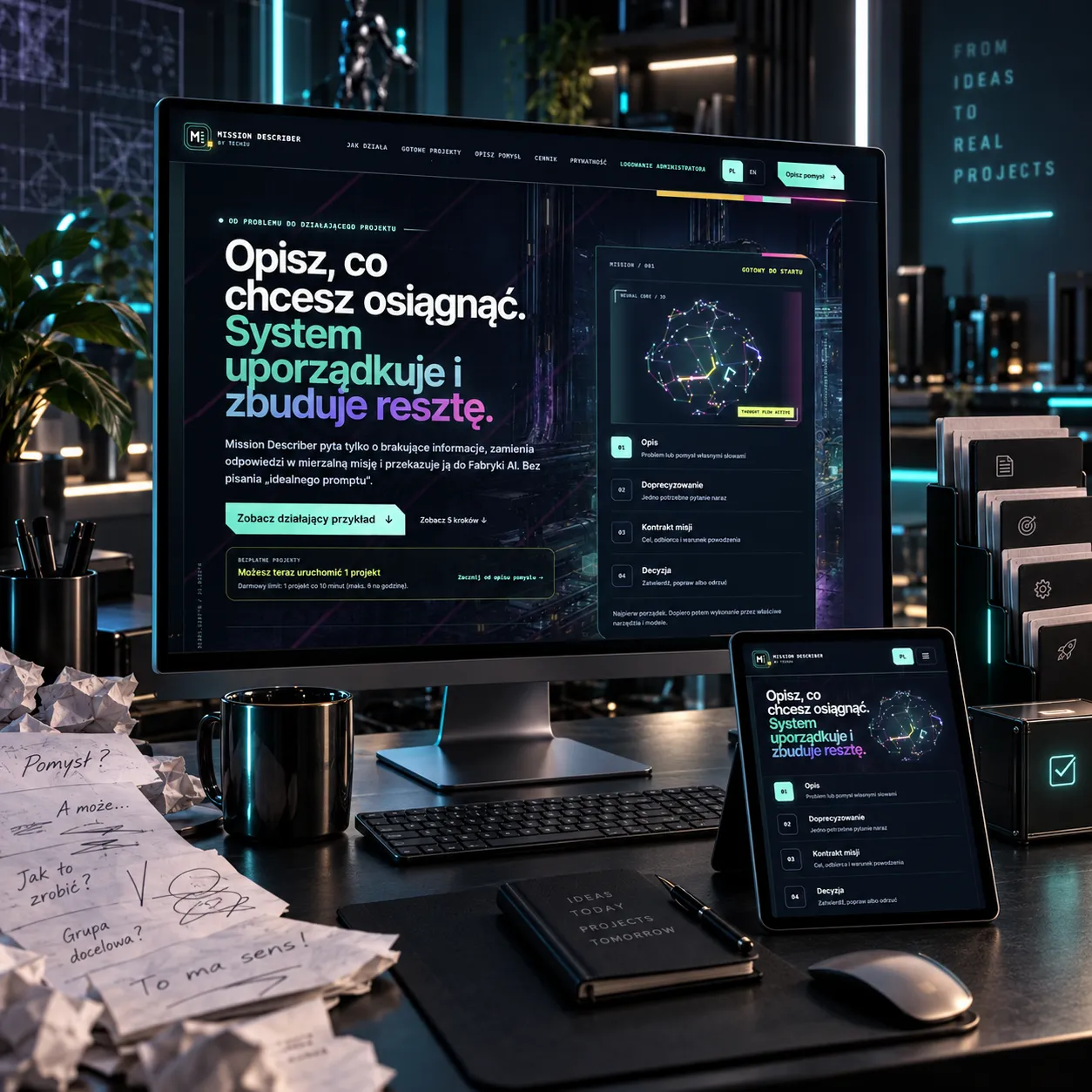
Tech2u audio edition
A narrated editorial edition using the Tech2u voice profile.
The concrete detail comes first, the conclusion second. Below we show the reasoning, its limits and what this story can genuinely add to your own work.
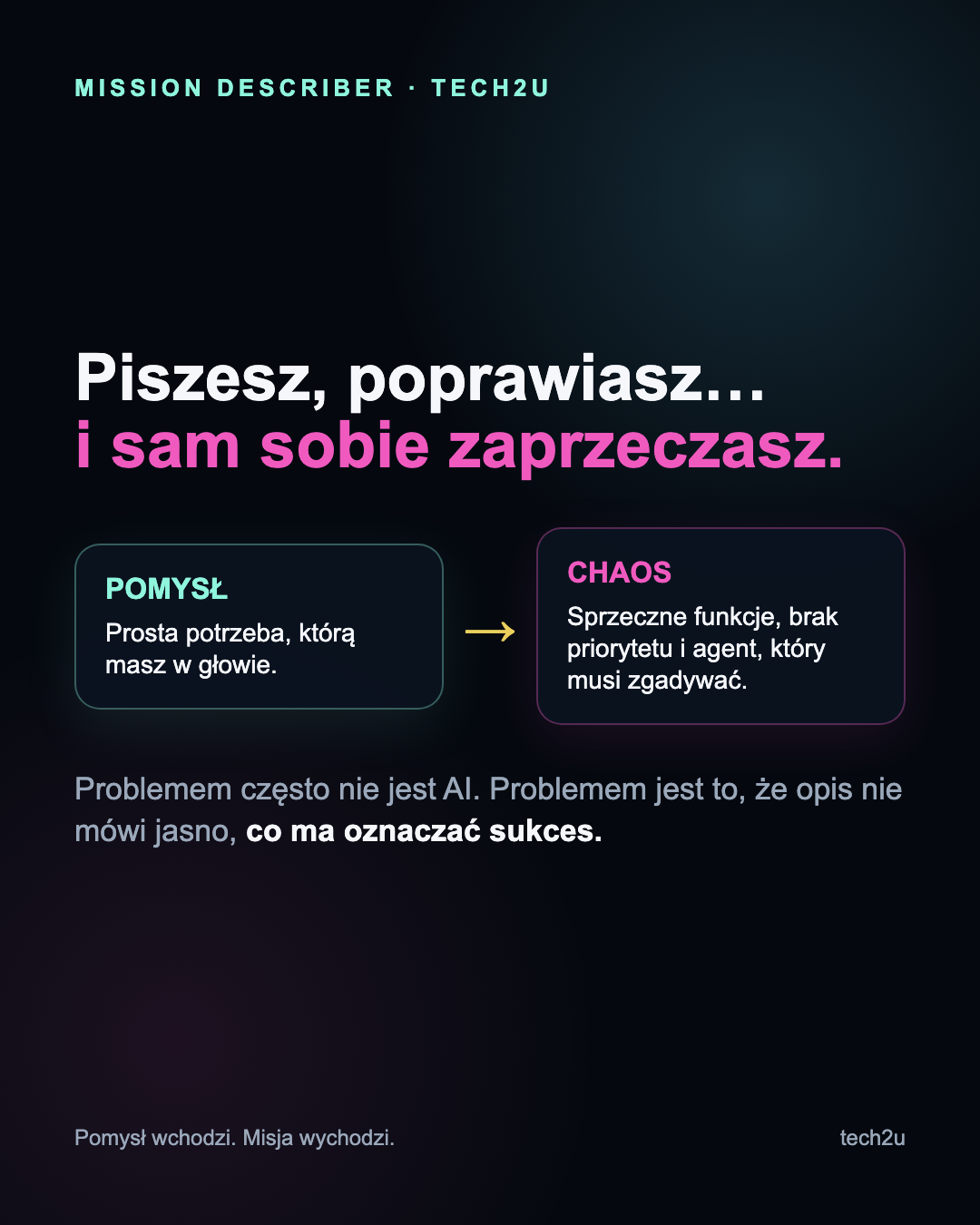
The most expensive AI mistake often begins before a line of code exists. We say, “you know what I mean.” We know, because the idea has lived in our head for weeks. The agent sees only the words we supplied, including the omissions, shortcuts and feature that begins contradicting the first requirement three messages later.
Mission Describer was built for that moment. I created it with Codex, so this article will not cosplay as an independent laboratory review. We know the product from the inside. What we can do is test the narrower and more useful question: does it solve the problem it was built for, where does it help, and where does its competence end?
A long prompt can still be empty
Word count is not a measure of brief quality. A request can spend five screens describing colours, animations and an admin panel without answering the basic question: what should change for the user?
The agent then receives a tasting menu without being told whether it should run the restaurant, deliver lunch or design the plate. It starts guessing. Sometimes the guess looks impressive. It is still a guess. Mission Describer reverses the order. It starts with the current situation, audience, intended outcome, boundaries and evidence of success. Technology comes later.
From an idea to an editable mission
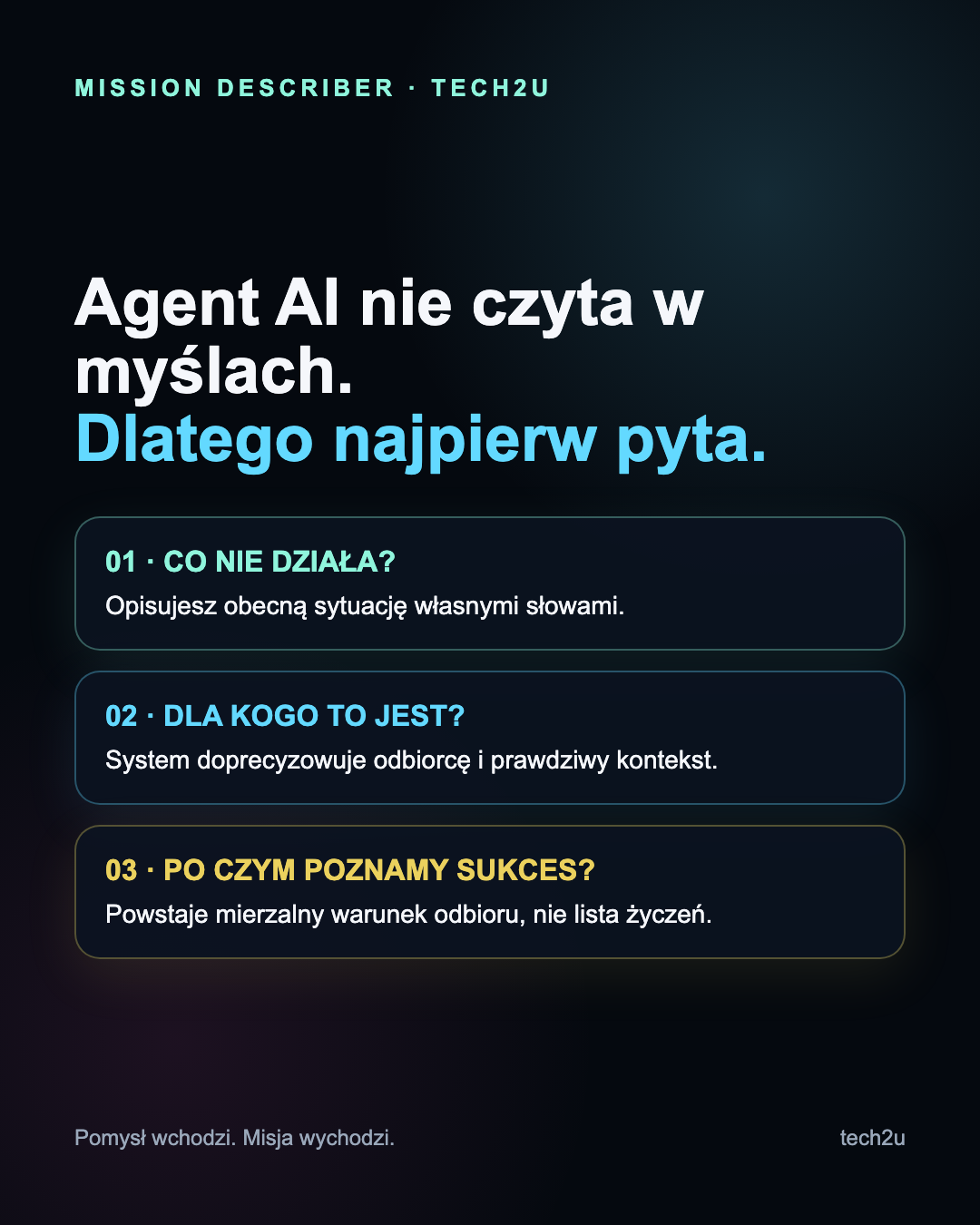
The public workflow exposes its stages. A user begins with a few ordinary sentences and does not need to know the preferred framework, hosting provider or architecture. The system conducts an interview, asking one necessary question at a time. The answers become a mission contract:
- Problem — what currently fails, consumes time or creates errors?
- Audience — who will use the result and in what context?
- Outcome — which observable change should occur?
- Boundaries — what must the system avoid, and which data stays outside?
- Evidence — which test will show that the result works?
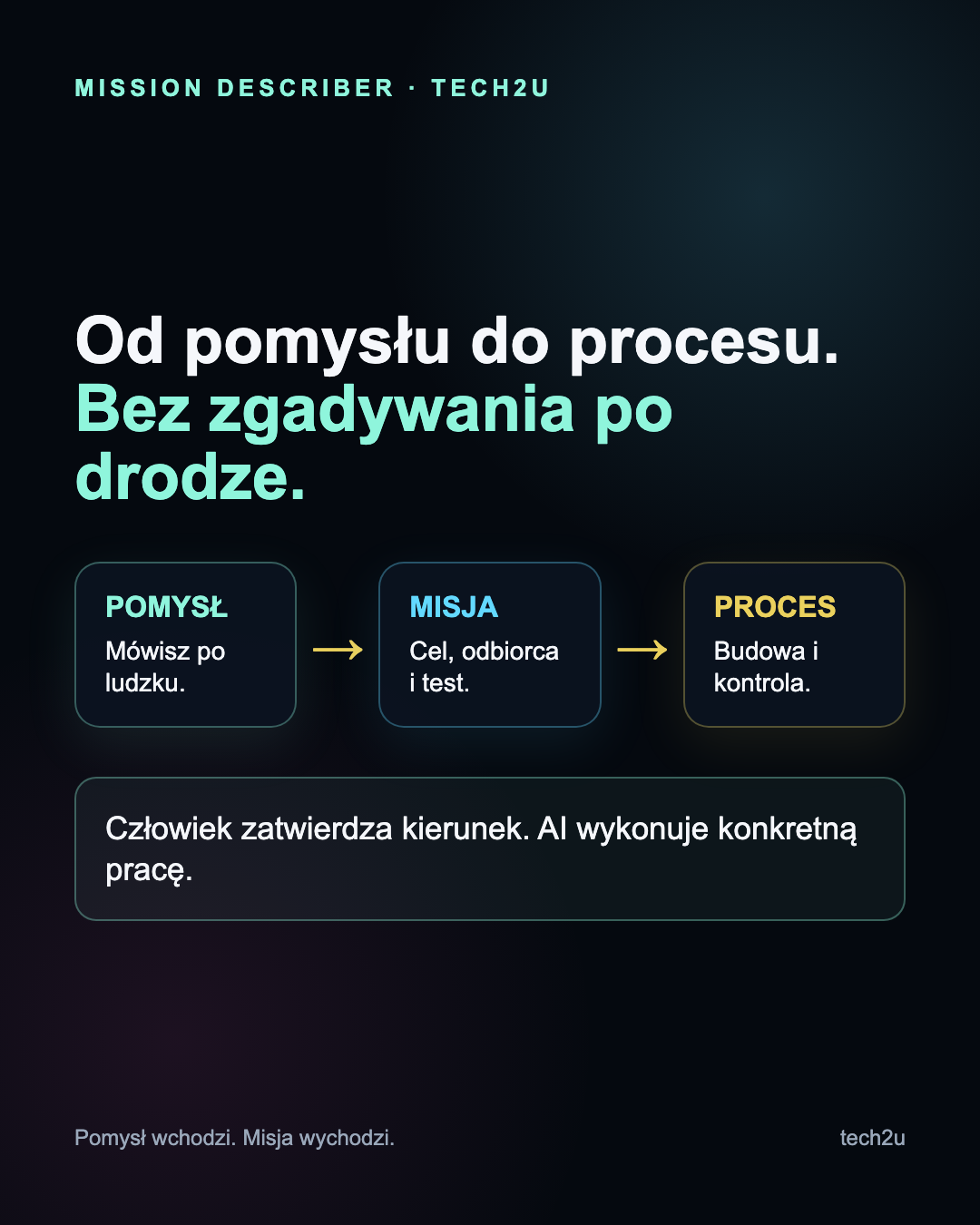
The crucial step is a human decision. The mission can be approved, revised or rejected. AI does not receive a crown and the keys to the server room. It receives a defined job after the direction has been accepted.
Three roles, one result
After approval, the interface exposes three roles: architect, builder and reviewer. The architect challenges assumptions and proposes the smallest useful solution. The builder creates the files. The reviewer compares the result with the success condition agreed earlier.
Three labels do not automatically create three independent minds. The value comes from separating responsibility and checking the output against a stable contract. If the criterion is merely “make it nice,” the reviewer can only shrug with excellent formatting. A progress bar proves activity. A working artefact and an acceptance check provide evidence.
A small example that can be verified
Mission Describer includes a functioning work timer. A visitor can start a session, finish it, add a task number and professional description, then save or export the entry. The data remains in the browser.
That is a useful proof because it demonstrates a complete chain on a constrained task. It does not prove that the system can safely produce any medical app, marketplace or financial platform. It supports a narrower claim: a controlled mission can become a testable tool.
Privacy cannot be a footnote
The public version says the interview remains on the device and the form does not require passwords or tokens. Visitors should still avoid entering client data, API keys, medical information or confidential material. “AI will help” is not a spell that removes responsibility for data. Sensitive projects require a controlled environment and an explicit transfer path.
What works best
Mission Describer’s strongest feature is not generating more text. It forces decisions before implementation. This is particularly helpful when someone understands the pain but mixes it with a favourite solution. “I want an AI app with a dashboard, notifications and charts” is a shopping list. A better question is: who makes which decision because of this product, and how will we know that decision became faster or safer?
Where the system stops
A user can provide a wrong answer. The tool may organise it beautifully, but it does not automatically know the market, law, budget or behaviour of future customers. A detailed interview also carries cognitive cost. For a tiny correction, the process can be heavier than the task. A good system should not convene a board meeting to move a button by eight pixels.
More independent cases are needed as well. Tech2u projects show that the method works in our environment; they do not represent every industry or risk level. The 8.4 score is therefore a transparent self-assessment, not a medal from an external laboratory.
Tech2u verdict
Mission Describer solves a real problem: before building faster, we must establish whether we are building the right thing. It gives structure to a conversation made of additions, exceptions and “one last small feature.” It is not a machine that turns every idea into a product. It is a filter between intention and execution.
Sometimes the best AI feature is not an answer, but the question a person skipped. Explore the public Mission Describer. The demo is for understanding the process, not for submitting confidential data.
Tech2u verdict
Mission Describer addresses the gap between a person's intention and the contradictory list of features an agent receives. Its strength is defining the goal, boundaries and evidence before implementation. It remains a developing system, not an automatic guarantee of a good product.
A Tech2u self-review based on the public prototype and process inspection. We co-created the tool, so this is not an independent consumer test.
+ Pros
- Starts with the problem and outcome
- Asks one necessary question at a time
- Creates an editable mission contract
- Keeps approval with the human
- Separates building from review
- Warns users not to submit secrets
− Cons
- A good mission cannot guarantee good code
- Quality depends on the user's answers
- The full process may be excessive for a tiny fix
- The public demo is not for confidential data
- Broad independent testing is still missing
 Reviews
Peugeot 408 beyond the striking design: which powertrain makes more sense?
We revisit Tech2u's Peugeot 408 video test: design, cabin space, i-Cockpit, luggage capacity and the difference between the 130 hp petrol and 225 hp hybrid.
Read the story Reviews
Free blog hosting: what Cloudflare Pages actually gives you
A practical look at Cloudflare Pages for a static blog: speed, limits, images, CMS options, domains and the important trade-offs.
Read the story